AI Automation Article
What is autonomous ai agent developer
Autonomous AI refers to systems that make decisions and take actions without human intervention. These systems perceive their environment, process information, and execute tasks based on predefined goals. An autonomous ai agent developer builds these systems—creating software that can operate independently in real-world conditions.
Think of it like a self-driving car. The car senses the road, identifies obstacles, decides when to turn, and navigates to a destination. No human tells it to brake or steer at each moment. That's autonomous AI in action.
Autonomous AI definition
Autonomous AI is artificial intelligence that can operate without human input. It uses sensors, data, and algorithms to understand its surroundings and make decisions. The system learns from experience and adapts to new situations.
The key element is independence. The AI doesn't wait for commands. It acts on its own to achieve specific outcomes.
How autonomous AI and autonomous agents work
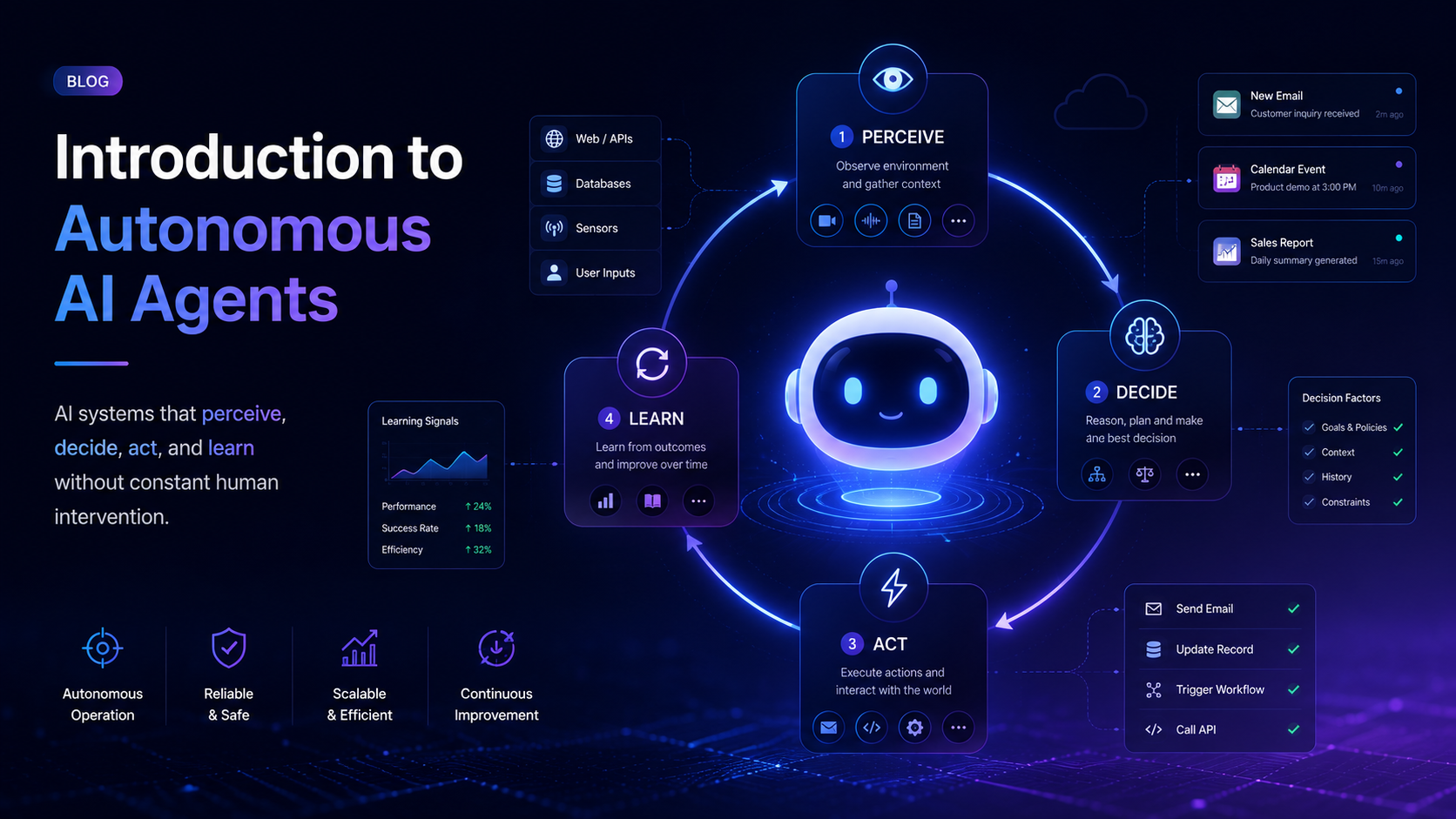
Autonomous AI systems follow a simple loop:
- Perceive - Collect data from sensors or inputs
- Analyze - Process that data using models
- Decide - Choose the best action based on goals
- Act - Execute the action
- Learn - Use results to improve future decisions
An autonomous agent is a software program that performs this loop continuously. An autonomous ai agent developer programs these agents to handle specific tasks like managing inventory, responding to customer requests, or monitoring factory equipment.
What's the difference between autonomous AI and generative AI?
Characteristics
Autonomous AI focuses on action. It does things. Generative AI focuses on creation. It makes things—text, images, music, code.
Autonomous AI systems operate in the physical or digital world. They control robots, manage workflows, and make operational decisions. Generative AI produces content based on patterns in training data.
Strategic roles in technology
Autonomous AI handles execution. It runs processes, monitors systems, and responds to changes. Generative AI handles ideation. It drafts documents, designs visuals, and generates ideas.
Companies use both together. Generative AI creates a plan. Autonomous AI executes it.
Main features of autonomous AI agents
Key features
- Goal-oriented behavior - Agents work toward specific objectives
- Real-time decision making - They act quickly based on current data
- Adaptability - They learn from new situations
- Autonomy - They operate without human supervision
- Sensor integration - They connect to cameras, microphones, or data feeds
- Feedback loops - They use results to improve performance
An autonomous ai agent developer builds these features into software that runs reliably over time.
Business benefits of autonomous AI
Efficiency and accuracy
Autonomous AI handles repetitive tasks faster than humans. It doesn't get tired or distracted. It processes data without errors. This reduces costs and improves output quality.
Personalization and customer experience
AI agents analyze customer behavior and adjust responses in real time. They recommend products, answer questions, and resolve issues without waiting for human approval. Customers get faster, more relevant service.
Strategic advantages
Companies using autonomous AI respond to market changes faster. They optimize supply chains, predict maintenance needs, and automate routine decisions. This frees human workers for higher-value work.
Common challenges when implementing autonomous AI
Challenges
- Data quality - Bad data leads to bad decisions
- Integration - Connecting AI to existing systems is complex
- Trust - People hesitate to let AI make important decisions
- Regulation - Laws around autonomous systems are still evolving
- Cost - Building and maintaining these systems requires investment
Strategies for responsible AI use
Start small. Test autonomous AI in controlled environments. Monitor results closely. Build in safeguards and human override options. Document decisions for audit trails.
Best practices for business leaders
Define clear goals before building
Invest in data infrastructure
Train teams on how to work with AI
Set up governance frameworks
Review performance regularly
An autonomous ai agent developer can help organizations avoid common pitfalls by designing systems that are transparent and accountable.
Real-world examples of autonomous AI agents
Healthcare
Hospitals use autonomous agents to monitor patient vitals. The system alerts staff when readings change. Some agents adjust medication pumps based on real-time data.
Manufacturing
Factory robots use autonomous AI to sort products, inspect quality, and adjust production lines. They detect defects and stop operations before problems escalate.
Finance
Banks use AI agents to detect fraud. The system reviews transactions, flags suspicious activity, and blocks payments without human review. This happens in milliseconds.
Transportation
Autonomous vehicles navigate roads using sensors and AI. Delivery drones follow flight paths and avoid obstacles. Logistics companies use AI to route shipments based on traffic and weather.
Build your own autonomous AI agents
- You don't need a large team to build autonomous agents. Start with these steps:
- Define the task - What problem do you want to solve?
- Collect data - What information does the agent need?
- Choose a platform - Use tools like Microsoft Azure AI or open-source frameworks
- Build a prototype - Start with a simple version
- Test and refine - Run tests, gather feedback, improve
An autonomous ai agent developer can accelerate this process by providing expertise in system design and deployment.
Explore other AI solutions
Reinvent productivity with Microsoft 365 Copilot
Copilot helps you draft documents, summarize emails, and create presentations. It works inside your existing tools.
Discover the power of Azure with AI
Azure provides infrastructure for building and running AI agents at scale. You get pre-built models, data storage, and deployment tools.
Perform security and IT tasks faster
AI agents can monitor networks, detect threats, and automate responses. They reduce the workload on security teams.
Frequently asked questions
What is autonomous AI?
Autonomous AI is artificial intelligence that makes decisions and takes actions without human input. It perceives its environment, processes information, and acts on its own.
What is the difference between autonomous AI and generative AI?
Autonomous AI acts. Generative AI creates. Autonomous AI handles tasks and operations. Generative AI produces content and ideas.
What is an example of an autonomous AI agent?
A self-driving car is an example. It senses the road, makes driving decisions, and navigates without human control.
What is artificial autonomy?
Artificial autonomy is the ability of an AI system to operate independently. It sets its own actions based on goals and environmental data.
What is the future of autonomous AI agents?
They will handle more complex tasks across industries. Expect wider use in healthcare, logistics, customer service, and manufacturing. An autonomous ai agent developer will be key to building these systems responsibly.